

articles/Wildlife/wildlifeyear
The Wildlife Photographer's Year
by Mike Jones
There are 'pixel peepers' as I call them, and there are photographers. All photography is art and in my time studying art I never once wondered what type of brush the great masters were using. I did, however, stand in awe at the skill and composition of the image. Technical competence is a given for a photographer in my book, but what makes the difference to an image is not the equipment that was used, but the skill that was shown to create and compose the image, and above all the skill that took place to even present yourself in that place in order to capture the image.
What I end up photographing during the year depends to a large degree on the time of year and what may be current for a talk or lecture. My work can also be influenced by any images that I am trying to obtain for sale.
The year for the British wildlife photographer depends on the type of photographer but for me I am open to capturing images of any wildlife that are in season. With a Scottish or coastal/upland leaning most of my work takes place up north with the occasional foray down south.
Although I have portfolios for most British mammals/birds, I am always trying to obtain better images for the areas in which I specialise. Unsurprisingly these are species such as wild deer, otters, seals, eagles and raptors. Sea birds are always on the list and all have their seasons which give a small time slot with which to obtain the images.
The first task for the wildlife photographer is not, however, to read technical journals on the latest photographic development but to study in depth the life cycle of the species that you are going to photograph. In turn you need to become an expert on the species and the field craft required to photograph the animal.
The following is brief description of a number of photographic subjects and the importance of understanding your intended subject.
Seasons and species
Red Deer
(Winter/Spring on the Isle Mull)
One of the first commissions that I picked up was to capture an image of a wild, red deer in Scotland. The iconic view of the red deer in the highlands may not be the most visually aesthetic image but it does sell pictures and occasionally you need to prostitute yourself to your art in order to make some money. So all that aside, with the task of finding a wild red deer stag with a set of antlers holding at least 12 points (known as a Royal in deer circles!) I set off around Mull only to find that stags shed their antlers in late spring and that every stag I found had recently lost its headset. So finding out that the antlers returned by late summer I next found out (upon my return) that the antlers are covered in velvet whilst growing and after calcification the antlers are unsightly with the the velvet skin hanging off. So another trip was pencilled in for the autumn and a chance to photograph the rut. And so this journey continued with the rut starting early and us arriving late! And so it goes on, and on.
Frustrated by this I looked into the prospect of photographing deer on the parkland estates of England. As convenient as this may be the parkland deer look nothing like wild deer and their diet and supplements give a hefty set of antlers but none like the wild deer of the north. And so 12 months after starting the project, I managed to find a Royal at the roadside in the light of a sunset. Not the image I was after, but still good enough to put in a frame to await the arrival of a potential buyer who wants to purchase an image of a proud and wild Royal photographed on the Isle of Mull.
Now had I taken the time to research my subject before setting out I might have avoided a wild goose chase and no small amount of frustration, more importantly learning the lifecycle of my subject would have made me a more effective photographer. The long-term objective has always been to improve and expand the portfolio every year until you can close the book on that particular subject (not happened yet on anything by the way!)
Seals
(Autumn in Scotland and the east coast of England)
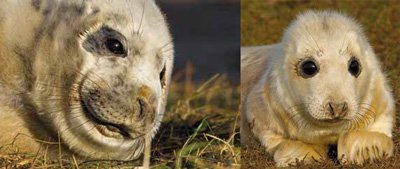
With an impending lecture on the wildlife of Great Britain I needed decent images of grey seals to complete the list and coinciding with another trip up north I had, on this occasion, done my homework on the subject. So get on a boat and head out to an island with lots of furry seals lounging on the beach? No - wander round an island in the pouring rain with winds so high that you cannot open the car door. Our trips had co-incided with the worst year for decades and boats that never actually left the harbour at any time that week. Plan B had to come into place and several visits to the east coast later I had managed to obtain enough material to complete the lecture. I do not, however, yet have the image that I want of the storm-battered rocks and the seal looking soulfully into the Atlantic. (Time yet and this autumn is already planned.) The pictures here are of a five-hour-old pup and a 10-day-old pup.
"...wander round an island in the pouring rain with winds so high that you cannot open the car door..."
Kingfishers
With half a dozen unsuccessful attempts at setting up a hide and the worst winter for decades which had killed off a high percentage of the kingfisher population I had almost given up any chance of putting together a portfolio on kingfishers. I have followed kingfishers around for years and have managed some opportunistic shots of these beautiful birds, but I have never been able to sit in front of a perching bird for any length of time. I know the theory and have even been party to setting up a stretch of river just in time for the bird to disappear (which I blamed on the local mink population). So with a promise of advance orders I was lucky enough to be able to use a hide that was already in situ and spent about 10 hours in it with good light. I left with about 500 usable images at the end of the day. Kingfishers, by the way, are a protected, schedule 1 bird and cannot be disturbed or photographed at the nest during the breeding season.
"I have followed kingfishers around for years..."
Eider Ducks
The UK's heaviest duck and its fastest flying. (More evident in the spring in Scotland)
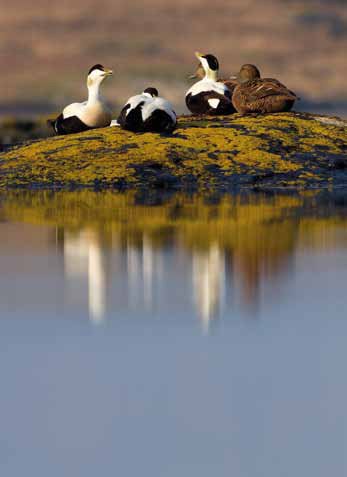
I had wanted to capture the behaviour of eider ducks at close quarters for years and like every other species of animal on the planet I had always been in the right place at the wrong time. But in the spring of 2011 a number of eider ducks had decided to set up base on the shore of the loch where we were staying. Every morning at 5am I set out down the loch and, kneeling in the water, I managed to get some images of the ducks displaying whilst sitting on their favourite rock at high tide. I did not see this behaviour the year before and I did not see it again this year. This year the eiders were based offshore on the remains of a mussel farm and the opportunity to photograph them never arose.
Mountain Hares
spring)
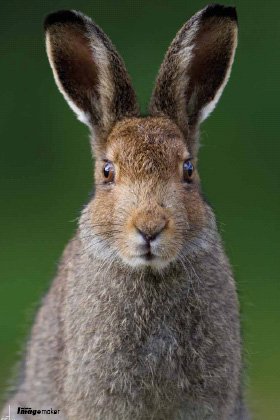
Now it is not always a tale of strife for the wildlife photographer and sometimes opportunities just arrive on your doorstep. Mountain hares had always been a subject that I struggled with but one year when we arrived at a lodge on the Isle of Mull I looked out to see a hare sitting and eating grass outside the window. Panic ensued and whilst I was thinking how I could get out of the kitchen window on the blind side of the lodge, the owner of the lodge strolled up to the door past the hare which did not flinch! I learnt in the next week that these hares ate grass around the lodges every day and really did not give a damn about a photographer lying in the grass in front of them. If anything I spent more time backing off from the subject as they got too close.
The Isle of Mull only contains mountain hares and there are no brown hares on the island. The mountain hare has a fatter face and is generally plumper in appearance.
Waxwing
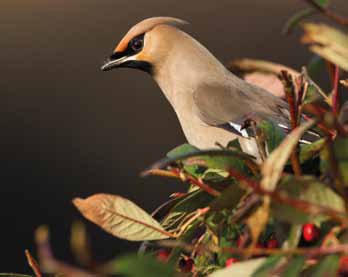
The 2011 year was a bumper one for waxwing and when we left Scotland they arrived in hoards on the island as we went. When we searched for them in the Lake District they managed to keep one step ahead of us, leaving just before we arrived on the scene, and when we drove all over the country the damn things were everywhere that we were not. I gave up and found so many excuses why I did not need an image of a waxwing. That was until I heard on the grapevine that a flock had arrived just down the road from home. I shot down there and a couple of days later I arrived at the same time as a BBC film crew. The birds arrived, I became star-struck, the BBC interviewed me and the birds left (leaving me on the cutting room floor, incidently).
I started to dislike those little birds until one day my wife rang and said that I needed to move myself (polite version) and get down to our local Sainsbury's supermarket where a flock had taken up residence in the car park. Last chance I thought and hot footed up to the supermarket. I chased them round a housing estate for three hours until at last they surrended and landed in front of me in blazing sunlight. I filled up several CF cards before the sun went down.
Coot
Last but not least in this snap shot of a life in the day of photographer is the annual pilgrimage to try to find the young of an animal and photograph the trials and tribulations of an adult trying to bring up their young in the wild.
One year, on a business park where my wife works, a pair of coots had hatched about 10 chicks and with a relatively easy subject ( as I thought) I started to follow the life of the offspring through the lens. I made numerous visits and managed to attract the attention of the park security who were convinced that I was casing up the bank offices across the lake. I convinced them that I was innocent of the charge and started to panic a bit as the numbers of the chicks were reducing every day. The culprit was a grey heron which not only was eating every chick on site but also chomping up the koi-carp floating round the lake. It appeared, however, that the coots had become used to my presence and while I was around the heron was not. The images that I ended up with showed me that coots do not actually eat the weed that they dive for but that they actually eat the shrimps that are attached to the weed. The shot of the coot shows the mother feeding a shrimp that it has dived for the offspring.
During 2011 we managed to clock up over 30,000 miles chasing after images of wildlife in the UK and during that time I learned a great deal about the subjects that I was photographing. I am often asked what advice that can give to photographers starting out in wildlife and I generally give the same answer. Buy a book on wildlife and read it from cover to cover, when you have done that think about how would like to see that subject in a photograph on your wall and then think about buying a suitable lens (and in my case forever ending up in debt).
As a general guide the following subjects are popular around the seasons.
January - Wrap up and head for the coast and wetlands where you will find geese, swans and waders.
February - Often the harshest time of the year and this is the time to either visit an established bird feeding station or maintain your own with opportunities to photograph woodpeckers, finches, tits and nuthatches.
March - With frisky hares in the arable fields this is generally the best time of year to photograph them and whilst lots of animals are pre-occupied with courtship, subjects such as frogs are more accessible at this time.
April - The natural world is bursting with life and the classic subject for the April courtship is the great crested grebe. This is also a great time to photograph snakes, with adders spending time basking in the weak April sunshine in an effort to raise their temperature. Don't miss out on butterflies emerging.
May - For those interested in macro work this is the time that dragonflies are mating round the clock and also the time that sea birds are increasing in numbers on the cliffs and crags of our coastline.
June and July - Peak times for viewing the young and devoting time to photographing the huge populations of sea birds in places such as the Farne Islands and Bass Rock
August - My advice is to take a holiday during August as the focal point for many will be the plants and animals in seaside rock pools. The month of September will see the start of the autumn activities such as the rut and dragonflies and damselflies are still on the wing.
October and November - These months peak with the thousands of grey seals littered around our coastlines and the rut for both fallow and red deer. Also in the lowland areas such as the estuaries short eared owls start to return to their winter roosts and become active, hunting during the daytime.
December - Can be a frustrating month because of the low light levels but birds start to return to the feeding stations, birds flock in wetlands and estuaries and redwings, fieldfares and waxwings start to make an appearance.

B.P.P.A. LIMITED
The Society of International Nature and Wildlife Photographers (SINWP)
Clwyd Chambers, Clwyd Street, Rhyl, Denbighshire, LL18 3LA, UK
Company Reg 0392 2894 | VAT number 790 4289 05
Tel: 01745 356935
Corporate Partners


Newsletter: Subscribe here
SINWP Bird Photographer of the Year
London Photography & Video Show - Europe's Largest 'All-Welcome' Photographic Convention | Partner Societies | Privacy