

articles/Nature/tools-trade
The Tools of the Trade with Jon Ashton
by Mike McNamee
Much of this topic could be duplicated in the section on Landscape photography and so we will skirt around some of the topics. By its nature, working in the landscape has many similarities to working with natural history subjects; all your weather gear is identical although stuff that does not rustle is an advantage for skittish species! The main differences concern the size and weight of the gear. A 24mm lens might be the landscape specialist's stock-in-trade but for many naturalists their equivalent is a 500mm f4 lens. This is a different ball game in terms of carrying, using and moving, and a significantly different game in terms of expenditure! Tripods too are bigger and heavier by some distance. In clothing terms, for landscape you care little about visibility (brighter is safer) but for nature your aim is to melt into the background. Hides may also be required. Additionally there are extra bits of kit for nature such as macro lenses, flash gear and low tripods.
Cameras
All DSLRs can be used but some have advantages. Fast focusing is vital for bird or mammal photography and also the speed of the motor drive framing rate should not be ignored. If you only get a fleeting look at a rare species you need to maximise the opportunity. Conversely, even when you have time for a leisurely look at a species, then if say, it is flicking its tail then one frame will always be better than another. This is brought home by the Gerlachs in their book (see this issue books' review). In more than 40 African safaris they have seen wild dogs just once and even then only for a couple of minutes - bash them out at twice the framing rate and you have twice as many to pick from!
The choice of chip size is a compromise. Smaller chips have effective longer focal lengths although this is not strictly true; all you are doing is cropping down from a full chip. However, because the field size is smaller, the lens designs can be lighter and you can make quite a saving with specialist smaller-format lenses. The 'downside of having to put up without really wide-angle lenses is not one to trouble the nature specialist. ISO capability and higher noise are the issues with smaller chips exacerbated by a frequent need to shoot in low light and almost always with fast shutter speeds.
Lenses
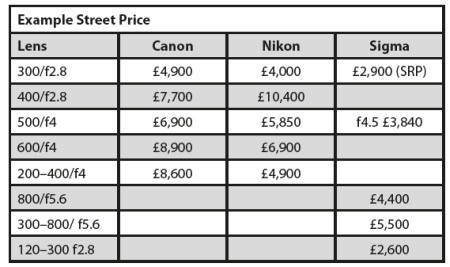
The big lenses of nature photographers are expensive. Wider apertures give better focus speed and the ability to couple teleconverters while retaining focus performance. Big lenses also need big supports and tripods, and gimbal heads can come to more than a landscape specialist pays for their other gear combined. Despite this, the bird photographers always seem to be able to find the money from somewhere! The table below indicates some of the street prices we found but note that the columns do not always compare like with like - but when you are spending this type of money you had better do more research anyway, right down to hiring before you buy! In general terms the price of a lens tracks the size of the front element. Analysis conducted in 2010 showed us that the relationship between front element diameter and cost is robust. Our 2015 analysis shows nothing has changed; some lens prices have actually fallen although some of the comparisons are not like-for-like because of aspheric element use and the introduction of stabilisation.

Gimbal Heads
Prices range from about £250 to £500. That might seem expensive, but there is little point in having a huge lens that delivers only fuzzy, camera-shaken images. Once you have a gimbal head in position and on firm ground, everything becomes very much easier. Popular makes include Sirui, Wimberley, Manfrotto and Custom Brackets. You are advised to do your own research before purchase. In terms of weight the Sirui Ph-20 head is almost a kilogram lighter than the Wimberley owned by your editor - things have moved on! Costs have also become more competitive; the Wimberley retails at £575 whereas the Sirui can be obtained for closer to £320.
On the right is a same-scale image of the Nikkor 300mm f4 against the massive Sigma300-800 f5.6 zoom. Hand-holding the Nikkor is relatively easy, the Sigma needs a gimbal!
Macro lenses
A search for 'macro' lenses in DP Review brought out 51 lenses in total but this included zoom lenses with macro capability. For the purpose of this feature, we culled the number down to 22 by only listing full-frame, true macro lenses which mainly (but not exclusively) reach a best magnification of 1:1. The fact that there are still so many lenses is an indication of just how popular this branch of photography remains.
The main issue facing the macro photographer is the small depth of field. Small chips provide greater depth of field at the expense of increased and earlier onset of diffraction limiting. However, the increased working distance of the effective longer focal length is a boon, especially with skittish subjects. A thing that newcomers to macro sometimes forget is that the rules of perspective still apply; a longer focal length gives a longer working distance and flatter perspective. While the longer working distance of say a 200mm macro lens is a benefit, the geometry of the situation leaves them more vulnerable to camera shake because the levers are longer. Subject movement is not affected as this depends only upon the magnification.

Nothing stands still for long! On 2 July 2015 Nikon announced two new professional super-telephoto lenses with the lightest build in their class: the AF-S NIKKOR 600mm f/4E FL ED VR and the AF-S NIKKOR 500mm f/4E FL ED VR.
Thanks to the use of fluorite glass, the lightweight build of these new lenses comes at no cost to image quality. At 3090g (approx.), the new 500mm lens is 790g lighter than its predecessor and actually weighs less than the current 200-400mm f/4 VR II. The new 600mm lens weighs approximately 3810g, and is an impressive 1250g lighter than its forerunner.
Prices
AF-S NIKKOR 600mm f/4E - £9,649.99 / €12,999.00
AF-S NIKKOR 500mm f/4E - £8,149.99 / €10,999.00

B.P.P.A. LIMITED
The Society of International Nature and Wildlife Photographers (SINWP)
Clwyd Chambers, Clwyd Street, Rhyl, Denbighshire, LL18 3LA, UK
Company Reg 0392 2894 | VAT number 790 4289 05
Tel: 01745 356935
Corporate Partners


Newsletter: Subscribe here
SINWP Bird Photographer of the Year
London Photography & Video Show - Europe's Largest 'All-Welcome' Photographic Convention | Partner Societies | Privacy