

articles/Nature/theashesseries
Paul Gallagher Landscape Photographer The Ashes Series
by Paul Gallagher
The idea for this feature came from the regular magazine swap that we do with Better Digital Camera and Better Photography Both magazines involve Australian, Peter Eastway, who edits one and publishes the other. We met briefly at Focus a few years ago, introduced by Malcolm Mathieson. Peter is also a busy landscape photographer who leads many courses and trips to places which seem very exotic from this side of the world - ranging from the icy wilderness of South Georgia, up to Papua New Guinea on the equator. He also produces a subscription web-based landscape master class and teaching programme, under the banner of www.betterphotography.com which is well worth a visit.
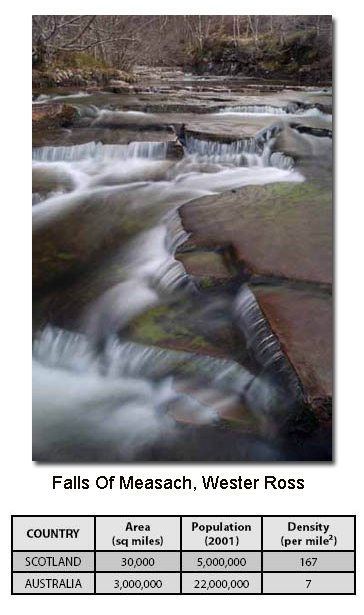
It struck us that there might be some mileage in comparing and contrasting the styles of Paul Gallagher and Peter Eastway, given that they are both landscape specialists but work in such different terrains and continents. Australia is a vast country, almost unimaginably so when compared with Scotland. Australia has one of the lowest population densities in the world, a wilderness indeed, much of it terribly hot!
In terms of area, Scotland occupies only 0.96% of Australia's, whereas the population is about a quarter. In terms of landscape Scotland in particular, is very compact and varied. Although Scotland and Australia were joined to the same continent of Gondwanaland 450 million years ago, Scotland was re-assembled from pieces of four continents at a later stage, which is why it is so geologically diverse. Despite this later divergence there are still some similarities between the coastal landscape scenery of the two countries, which makes our comparison a little more interesting. Comparison of Paul Gallagher's work and that of Australian, Alex Cowley (www.scenics.co.au) who is a features editor with Better Digital Photographer, is also an interesting exercise; their images share many common elements.

It is difficult to allocate definitive descriptions to the work of Paul Gallagher and Peter Eastway. Peter tends towards more panoramic vistas with a much heavier element of image manipulation to inject additional drama; Paul is more understated and more frequently uses a portrait format, perhaps because of his more favoured use of 5x4-inch format, which does not generally lend itself to letterbox panoramas. Paul rarely moves much beyond a polarising filter, a grad filter and a bit of dodging and burning; if you follow Peter's web tutorials you will immediately note that he has a much bolder digital approach.
Perhaps it is also a sunshine thing, I remember discussing the work of Jane Conner-ziser and Marylin Sholin with Jane herself and pondering the difference between the palettes they each employs. Marylin uses much bolder colours which Jane feels are more able to sit comfortably on the walls in Marylin's Florida homes, which tend to be white-walled, airy and brightly lit with abundant sunshine.
While both Paul and Peter use large-format Epsons to make their prints, their camera gear is quite different. Paul's is well known to our readers and comprises silver gelatine 5x4 for monochrome and (more recently at least) a Nikon D700 with his presently favoured 24mm Tilt/Shift Nikkor. Peter employs a Phase One camera, mainly the 645AF with 28mm, 75-150mm and 300mm lenses. For '35mm' DSLR work he uses a Canon 1Ds Mark III with the full range of lenses and frequent use of pan stitching to create his wide, letterbox images. He too is a fan of shift/tilt lenses but, as a magazine editor, he frequently employs gear he is reviewing.

If there is a single thing that links both their approaches it is the use of long exposures from rock-solid tripods to produce the sparkling quality we expect from them - there are no shortcuts in landscape, and that also includes getting out on the hill early!
Any attempt to categorise or pigeon-hole either of their work is likely to be mocked by the next image they create; like all shakers and movers of our industry they search restlessly for new ways of making landscape statements and this is much to our benefit. This Ashes series at least was always going to end in a draw! Despite this we found some amusing echoes within the selected pictures in terms of shapes and forms; it's been a real pleasure to put together!

B.P.P.A. LIMITED
The Society of International Nature and Wildlife Photographers (SINWP)
Clwyd Chambers, Clwyd Street, Rhyl, Denbighshire, LL18 3LA, UK
Company Reg 0392 2894 | VAT number 790 4289 05
Tel: 01745 356935
Corporate Partners


Newsletter: Subscribe here
SINWP Bird Photographer of the Year
London Photography & Video Show - Europe's Largest 'All-Welcome' Photographic Convention | Partner Societies | Privacy