

articles/Film/supernova
Film processing for large-format film
by Paul Gallagher
As mentioned in other articles, I moved through the formats to achieve an increase in image quality along with taking full advantage of image control that the movements of a large-format camera can offer. The general principles of using my usual film in a larger format and mastering the craft of large-format processing was something that I had read about and mentally planned. In a way I knew roughly which problems I could encounter using the larger format camera and how I might overcome them. The one problem that did catch me out was trying to obtain perfectly even development of a sheet of film, which I did not regard as being vast leap from my previous 6cmx7cm format. In roll-film many of the processing tank systems look pretty similar and offer the same results, and, having used many of them over the years, I had confidence in them. When I began to look into the ways of obtaining the same reliability and consistency of results with 5x4 sheet film, things began to go wrong and I soon realised you could not take for granted what manufacturers declared in their blurb
Firstly I embarked on the cheap "cutting corners" approach and followed some dodgy advice given to me by trying to modify an old Paterson roll-film processing tank so it could accommodate sheet film. I rather ridiculously filled the tank in the same way I had always done with roll-film with the daylight lid on and happily agitated away to find the resulting negatives to be fantastically streaky and unprintable. Back to the drawing board for Mr Scrooge! Still clinging onto the comfort of loading the sheet film in darkness and processing as I always had done in daylight, I bought another processing tank whereby after you loaded the film in the dark you could then fill and empty the tank with your series of chemicals, agitate at will and finally open the tank to see the end results. Although these results were a vast improvement on my home-made effort they came nowhere close to what I was used to with my roll-film. I had no option but to accept that I had to complete the entire sheet-film development process in total darkness and after some simple research there were two main options available to me - a dedicated Dip & Dunk processing unit or using small darkroom trays. The latter conjured up visions of soft emulsion being scratched by fingernails, and film edges and sheets sticking together along with not knowing were I was with agitation and temperature control problems. Although this was very much the cheaper option Mr Scrooge had now joined Jacob Marley and I was willing to pay money to save the cost of wasted film, time and lost images.

I contacted Nova Darkroom needing a shoulder to cry on and in their inimitable reliability they offered me the answer to my problems in the form of the Nova FP 5x4 Dip & Dunk film processing unit. This consists of a sheet-film holder borrowed from the CombiPlan system and five individual tanks each holding a little over a litre of chemical. Each tank is located into an overall temperature-controlling unit that holds four litres of water. It can maintain an accurate temperature within 0.2°C via its Nova Powerstat which is pretty impressive. Opening the delivery box, I was struck by how compact the system actually was, measuring in at approximately 46cm x 28cm x 17cm. So if, like me, you only need a darkroom to process films ready for a scanner, this was ideal.
Conditioning the Chemicals
I filled the processor with the volume of water required and all the other chemical tanks. I then placed the floating lids directly onto the chemicals to reduce oxidation and evaporation and fitted the tank lids. I then set the temperature to 23°C on the Powerstat (my processing temperature) and left it to its own devices. After about four hours (although the recommended time needed is two to three hours) I returned to find all chemicals at the exact temperature and ready to go.
Film Loading
I now had to learn how to load film into the negative holder that can hold up to six sheets of film during a single processing cycle. The holder is supplied with two ingenious negative guides for each side of the holder. These are surprisingly simple to use, and effective they are removed prior to processing. I began by practising in daylight with a "bad" negative (As mentioned by this stage I had many to choose from!) and then increased confidence by completing the task seamlessly with my eyes closed. After the film is loaded it is then secured by a film clip, which slides into place until it prevents the film from moving up and down during processing. I was now ready to process film. The beauty of this system is that you process using a very even and constant agitation. You are not throwing the chemicals "around" the emulsion as with a tank inversion agitation but simply lifting and replacing the sheets of film held in the negative holder from each chemical enabling a much more controlled approach to agitation very similar to that of tray processing where the film is moved "within" the static body of processing agent. As mentioned I regularly use two bath developer so with this processor I could have my first tank as a pre-soak, the next two designated as Bath A and Bath B developer followed by stop and fix.

The Results
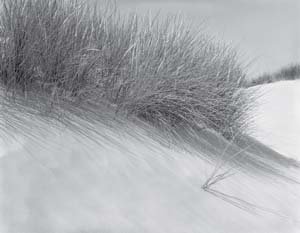
The initial results from the processor were fantastic and a marked improvement (see opening spread image). I simply followed the agitation frequency I had employed with other roll-film tanks in the past but lifted and re-immersed in these tanks or "Dipped & Dunked". I must admit I found it a little tricky at first, lifting and locating the negative holder into the next tank as each tank is so close to the next, but after I became more familiar with the unit it became second nature despite working in complete darkness The only problem I encountered was some slight increase in emulsion density below the upper film-retaining clip, which was created as the developer "rushed" past the clip as I over enthusiastically lifted the negative carrier out of the tank in the early stages of development. It must be said that this was further accentuated by the type of developer I use which requires an agitation every three seconds which is extraordinary compared to most products which allow stand times of 30 to 34 seconds per minute.
Conclusions
Overall this is a very well-designed piece of largeformat film processing kit. It is wonderfully compact, maintains temperature accurately, is simple to use and with floating lids and tank "top" lids the unit can be regarded as on-standby and, after a short warm-up time, ready to go. The other advantage I have not mentioned as yet is the efficiency of the unit. Using just over a litre of chemical per tank this is far less than tray processing or some deep tank options I considered which require industrial quantities.
On the edge of the processing unit is a Nova label bearing the words "We care how you develop". Although this is quirky and raises a smile I think it is true and is reflected in the design of this little gem.

B.P.P.A. LIMITED
The Society of International Nature and Wildlife Photographers (SINWP)
Clwyd Chambers, Clwyd Street, Rhyl, Denbighshire, LL18 3LA, UK
Company Reg 0392 2894 | VAT number 790 4289 05
Tel: 01745 356935
Corporate Partners


Newsletter: Subscribe here
SINWP Bird Photographer of the Year
London Photography & Video Show - Europe's Largest 'All-Welcome' Photographic Convention | Partner Societies | Privacy