

articles/Nature/steve-seagar
Steve Seager - Interview by Mike McNamee
by Mike McNamee

Steve Seager has the job that many people would die for and those who don't fancy it for themsleves remain envious of what he does? The reaction of people I told about what he does for a living suggested it was well worth a write-up.
After completing an honours degree in International Wildlife Biology, Steve took a three-month guide and ranger qualification at Antires Nature College (www.naturecollege. co.za). His course led to an FGASA qualification (Field Guides Association of South Africa) - the Antires website also lists some other interesting courses such as their Dangerous Animals module which includes all the techniques necessary to look after yourself in extreme conditions including shooting. Steve, incidentally, goes about armed with nothing more than a pepper spray of slightly dubious efficacy! He followed this course with a placement at the Selati Private Game reserve, working for Leo Africa (www.leoafrica.org). This is a privately owned game reserve held by a number of stakeholders and extended to 33,000 hectares. The estate holds a diverse population of African wild life including some of the less well-known but very important species. With six employed guides, the reserve provides experience for up to 14 'volunteers' at one time. These paying volunteers come for a variety of reasons from furthering their postgraduate studies to gap-year working vacations. The guide's job is to keep the volunteers safe while they learn their craft and interact with the animals.
Professional Imagemaker caught up with Steve on a recent return to the UK, as he was preparing to fly back to the reserve to carry on his work there. Having initially set him up with some 'wildlife' photography training, we were anxious to hear how he was getting on, but also took the opportunity to brush up his Photoshop skills and introduce him to drone technology!
Tell me a bit about the reserve that you work on
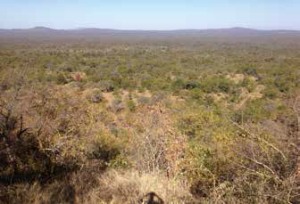
The reserve is 33,000 hectares of what is known as bush veldt or a 'savannah biome'. This is clusters of acacia/combretum in a grassland penetrated by granite intrusions that are called 'koppies'. These koppies are up to 50 metres in height and are used by the top predators as lookout posts. The elephants also climb up them occasionally. They help us look out for poachers and to search for species hiding in the long grass.
Poaching is a terrible problem in the game parks. Rhino, in particular are hunted for their horns in a completely misguided notion that they have medicinal properties. Even dehorning them is no guarantee of their safety, the poachers have been known to kill rhino to collect the remnants of the horn stub. It is a significant part of the guide's job to watch after their animals and protect them from poachers. All reserves have armed anti-poaching units, but such are the extents of the reserves that even then it is difficult to guarantee the safety of the species.
How is your typical day on the reserve organised?
There are two types of day, game drives and animal monitoring days. For game drives we get up at around 6am and set off in our modified Toyota Land Cruisers at 7am. The drive typically lasts for five hours and we come back to base at lunch time. Then we go out again around 3pm and stay away working until nightfall around 6pm, before getting back at around 7pm.
The animal monitoring days last from 7am until 5pm. Quad bikes are used for transport and we may take a volunteer with us to teach them tracking skills. Radio telemetry is used to locate specific animals so that their health can be assessed, as well as checking who they are hanging about with. En route to find a particular animal we will record the location and numbers of other herds in the park. Although the reserve is 'only' 11 miles north to south and 14 miles east to west it is an all-day job to travel across on a quad bike. We teach the volunteers telemetry which is more of an art than a science and often only places the guide in the general vicinity of the animal. Once we get close we have to leave the vehicle and stalk in so that the assessment can be made. Vigilance is paramount during this stage, you have to know the direction of your vehicle at all times and keep an eye for useful trees up which to climb in an emergency. Not all the animals have collars and so you have to be aware that the collared one is possibly hanging out with companions. We know our animals quite well and we don't want to find that a placid one we are stalking is teamed up with an unpredictable companion! Poachers too are an ever-present threat.
If the day finishes early we are tasked with climbing a nearby koppie and spend the time until nightfall scouring the terrain for any signs of unwanted activity that might require calling up the anti-poaching unit. As the lions also use the koppies as lookouts we have to take care to check who is around while we are absorbed in our searching.
I know from previous chats (and Facebook) that you have had a few 'moments' - tell me about the spitting cobra.
The spitting cobra is one of the most venomous snakes around. It can direct its venom into the eyes of a large threat (including a human) which can blind the victim. The actual venom can kill within minutes if delivered through a bite. You are recommended to stay at least 10 metres from a cobra. As rangers, we are often called to deal with snakes if they visit the lodges or camps. On this particular day we had been to deal with a cobra and had captured it, with the aid of a stick and stainlees steel bin (with a piece of carpet as a lid). We are naturally not allowed to harm ANY wildlife and so we drove our new friend several miles up the road and set him free in the bush.
Later I returned to my tent in the dark and heard a hissing noise after I had opened the flap and stepped in. Then my torch caught the cobra in the beam, wrapped around the tent pole and flared up in its threat posture. It was just a metre away. As I back out the snake slithered down the pole and disappeared into the darkness at the back of the test. Now I was confronted with the conundrum - had it left the premises or was it hiding in my sleeping bag? All these deliberations were not helped by the tiny mouse that was cowering, terrified, in the netting at the top of the tent - the mouse was not sure where the snake was either! I survived the night but it was rather restless and not much sleep was had by either me or the mouse.
Any other incidents that your mother would not want to know about?
The reserve has two lionesses who are sisters and tend to hang out together. One of tem is collared the other not. They have been 'contracepted' and this has had an effect on their pituitary systems, leading to an increase in weight. So, they are fully grown but a bit tubby and known amongst the staff as the 'Two Fatties'. They are not unduly aggressive or unpredictable, as long as you don't corner or surprise them.
We were out looking for them to do a routine health assessment, myself and a volunteer. We had located the collared one and were moving in to get a visual. She was well hidden and we startled her, causing her to make a mock charge and stand her ground. Now you never lose eye contact with a lion facing you off like this, so we were backing slowly away maintaining a concentrated stare and trying to look tough and cool. Unbeknown to us the sister was hiding in the long grass and had crept up to see what the commotion was all about. We turned to find her just 10 feet way - terrifyingly close, she could have closed the gap in a single leap. Now we had two lions to maintain eye contact with AND find the quad bike as well! We made it but there were two heavy-breathing people back at the vehicle.
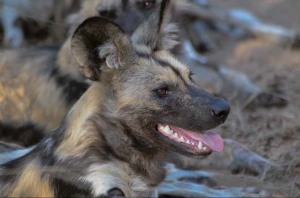
The African Painted Dog is often top of the tourists' 'must see' list. How did you get on with them?
The dogs form up into packs of around 20 but occasionally up to 30 dogs. They are highly social animals, a little larger than a Labrador Retriever, but with larger jaws. They are unusual in that after a kill they stand back and allow the cubs to have first pick at the carcase, they will go and collect the cubs from their crèche and bring them to the fresh kill. Each pack has an alpha male and alpha female and a pecking order within both sexes. Only the alpha female breeds, but the 'aunties' all pitch in and help with baby-sitting while the pack is out hunting. For hunting, the painted dogs are the Mo Farahs of the canine world, they can run fast, for hours on end. They collaborate while hunting, wearing down their prey animal to the point of exhaustion and then the whole pack moves in for the kill. It is not a pretty sight, the prey animal, sometimes as large as water buffalo is despatched very quickly by evisceration.
The dogs have huge ranges, stretching to hundreds of square miles (average territory is 700km2 per pack) and even with tagged dogs finding them with telemetry can take days, especially in hilly terrain. In this instance it took two days to find them and then we were able to move closer by Land Rover. They are curious animals and quite tolerant of vehicles. Doing any type of population census work is a nightmare because, when resting, they all pile up in a sociable heap and it is impossible to count heads and legs, especially when they keep changing position. As a species the dogs are under severe population pressure through a shrinking range of suitable territory and traditionally have been persecuted by the local tribes people because of raiding livestock; sheep and goats are easy prey for the dogs. Conversely if one dog is shot, the others come in for a look and can be picked off by an ill-intentioned farmer. However, their appeal to the tourists (as many as 40% come specifically to see the dogs) is working in their favour and the local farmers are being taught to modify their care methods (mainly by staying with their herds, this keeps the dogs away) and they are starting to realise that the dogs can bring lots of revenue in.
Tell me about the helicopter herding
This occurred while visiting some friends up on a reserve in Botswana. We were using a Robinson 22 helicopter as a 'sheepdog' to assist in moving a herd of elephants back inside a secured reserve. We had opened up a gap of 400 yards in the fence to herd them through. Unfortunately the helicopter was delayed and arrived quite late and in our rush to complete the job before nightfall we spooked the herd leaving the matriarch inside the secure area but the 15-strong herd outside. The herd was quite stressed at being split up so we decided to risk leaving the gap open. We ran a quad bike along the gap to make fresh tracks on the surface and retired for the night. The tracks would enable us to see what, if anything, had moved in or out of the reserve during the night. Fortunately the herd crossed to join the matriarch during the hours of darkness and so all was well and we were able to secure the fencing the following day with the herd safely inside.
Drone Flight
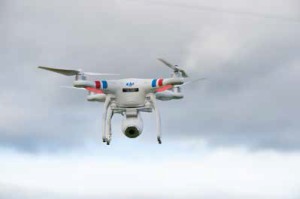
One of the objectives of Steve's visit was so we could show him the DJI Drone in operation. This is a most interesting application of this new technology. As described in the article, Steve often finds himself away from the relative safety of his vehicle, exposed on the grasslands with nothing more substantial than a pepper spray to ward off lions (or even bigger game). He was interested to see how well a drone could be used to fly over an area and make as assessment of what was in the area. Your ferocious editor was sent off the hide in the savannah that is New Brighton sand dunes and after an interval Steve launched the drone on a search and identify mission. It was a useful and interesting exercise. He had little idea where your editor was hunkered down and eventually had to fly higher to scan a larger area. Eventually the lesser dappled editor was spotted and broke cover, running gaily across the sand dunes (look somebody has to do it!). Steve was able to lock on the camera and follow for what would be a realistic time to record and identify an elephant (some would say there is little difference!). Overall it was a successful demo and we can't wait to see if Steve can implement the technology successfully in Africa.
Animal Rescue
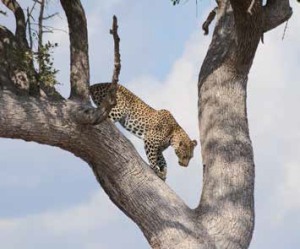
While we were giving Steve's photo skills a bit of a polish, we set to work on a series of shots of a leopard. The animal had been resting in the branch of a tree and caused a lot of excitement among the game park volunteers. It's the usual problem that comes with photographing in groups - people jostling about in the vehicle, causing blurred images even under fast shutter conditions. Steve was devastated at the loss of the shots; this was the first sighting on the reserve (hence all the excitement!). We tested out one of the later filters that has been added to Photoshop. Originally showcased at Adobe Max 2011 and living under the Filter>Sharpen menu, it is called 'Shake Reduction'.
Now this is a seriously beefy filter. We noticed the workstation starting to grind a little and checked the performance parameters - all eight processors were maxed out! It took just on 20 seconds to deliver its initial guess at the required settings and when we accepted these, it took a further 139 seconds to complete the operation. It is thus a slow filter to use and just as slow to make adjustments and refinements. However, as we found out, if all you have is a fuzzy, ruined image it did recover sufficient usable detail for us to make an acceptable A4 print. It's not going to win The Societies' 16x20 competition but it is good enough to show around

B.P.P.A. LIMITED
The Society of International Nature and Wildlife Photographers (SINWP)
Clwyd Chambers, Clwyd Street, Rhyl, Denbighshire, LL18 3LA, UK
Company Reg 0392 2894 | VAT number 790 4289 05
Tel: 01745 356935
Corporate Partners


Newsletter: Subscribe here
SINWP Bird Photographer of the Year
London Photography & Video Show - Europe's Largest 'All-Welcome' Photographic Convention | Partner Societies | Privacy