

articles/Lens/sigmaapo50500
Sigma APO 50-500mm F4.5-6.3 DG OS HSM Versatility Extended?
by Mike McNamee
First Impressions JA
The lens comes supplied with a well-made protective lens case with carrying strap; access to the lens is quick. The lens is well engineered and of solid construction. The finish is matt black and looks great - when brand new. Having used the lens extensively for several weeks the finish is still good but minor marks are evident, many scuffs do remove readily with a damp cloth, but the lens does have to be handled with care otherwise scratches will soon appear. This applies to most of Sigma's new lenses and I feel it is a potential shortcoming in that, after a couple of years' use, the lens could appear quite untidy unless very well cared for. I personally do not find it too difficult to take good care of my equipment - unfortunately though minor knocks and scrapes are inevitable.
The lens is actually significantly larger than the Canon; the Sigma dimensions being 104 (D) x 219 (L) mm, the Canon 92 (D) x 189 (L) mm. It is also significantly heavier being 1,970g as opposed to 1,360g. These weights and dimensions my prove a little misleading because in practice I found the lens to be very well balanced when on the camera body (a Canon 7D) and easy to hand-hold at all focal lengths; this, however, should be tempered with the fact that I am accustomed to handling a Canon 500mm f4 L IS lens!
The zoom action of the lens is by means of a zoom ring, and the action is firm; it can be locked at the minimum focal length, but not at other lengths. Zoom action is a matter of personal preference; I found the zoom ring to be smooth and easy to use. The Canon 100-400 is a pump action and I find it quicker and easier to follow, for example, a bird in flight coming toward me. The Sigma's minimum focal distance is close, ie 0.50-1.60 metres compared to 1.80 metres for the Canon 100-400L IS and the macro ratio is also very good being 0.32x as opposed to 0.20x for the Canon. Neither of the lenses has weather sealing.
In Action JA
I used the lens extensively over a period of weeks. It was used hand-held and also mounted on a tripod. When walking about and hand-holding the lens I carried it by means of the len's strap (supplied with the lens). I found this a better option than using the strap on the camera body. When mounted on a tripod I found the reference marks on the lens barrel useful when moving from a horizontal to vertical format and the locking collar was smooth and slick in use.
The lens hood was attached and removed easily; unfortunately there was a tendency for the lens hood to work its way loose and drop off when walking about with the lens over my shoulder. The lens cap was well designed and could be readily replaced and removed with the lens hood on or off.

Focusing was for the most part quite quick and accurate, and when the lighting conditions were favourable I noticed little difference in terms of speed or accuracy when comparing to the Canon 100-400. When lighting conditions were less favourable, eg when photographing a great tit in shady conditions and the contrast was lower, I found the Canon lens to be much quicker and it would snap into focus when the Sigma would resolutely refuse; quite simply I got images with the Canon and I did not with the Sigma. When in more favourable conditions both lenses operated similarly. Under all lighting conditions I found that the 500mm Canon was faster at focusfollowing, perhaps a reflection of the wider aperture and the more than four-fold price difference!
Resolution Testing MMcN
For quantitative testing we employed the Stephen Westin ISO 12233 resolution target (for resolution, contrast and chromatic fringing) and the Macbeth Chart for colour using ACR Calibrator to measure the colour precision. All are influenced by the camera body used and in this case we employed the new Canon 7D (which is a part-frame model, 22.3mm x 14.5mm, 16.1 megapixel, CMOS chip).
The lens showed a small amount of vignetting at 500mm and full aperture amounting to about 0.35 stops (centre frame to corners).There was some fall off in resolution out towards the edges but the chromatic fringing was a more serious flaw. The edge chromatic fringing was removed using Adobe Camera RAW and settings of +16 Red/Cyan and -33 Blue/Yellow. For the Canon 100-400 values of about half this were needed (+8 and -16 respectively). By comparison the Canon 500mm lens needed no correction at all.
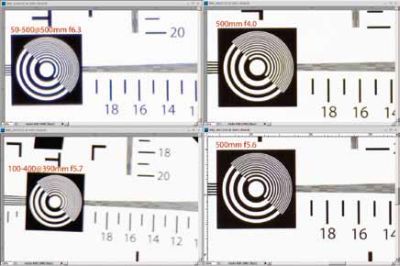
The resolution charts illustrate the differences in the lenses, the zoom lenses were significantly softer at the edges and the Canon 100-400 was soft in the centre also. The 500mm prime lens was considerably sharper and cleaner at both the centre and edges even though the aperture was a whole stop or more wider. Again the difference in price is justified by the improved performance of the prime lens but it requires such a huge leap in expenditure that comparison is scarcely a reasonable one to make. However, the lighter weight of the Sigma compared to the 500mm prime Canon lens is highly significant; there are certain tasks for which lugging a 500mm lens up a hill is just not worth the effort, a 50-500mm lens covers almost anything you can think of. This only leaves the matter of aperture. There is a huge difference between an f6.3 and an f4.0 lens in terms of exposure versatility, the extra stops can make all the difference when they are employed to use a lower ISO rating.
Colour
Lenses introduce their own colour to an uncorrected image. This is not an issue with RAW files where we can now calibrate even for an individual chip. To this end we shot the Macbeth Chart and then performed both ACR Calibration and error measurement. Here is what we found:
To all intents and purposes there is nothing to choose between any of the lenses and although they did create slightly different base tones, all things are correctable using camera RAW! These values are in line with the best acheived on a calibrated DSLR.
Stabilisation
Image stabilisation is difficult to test objectively. Overall we found that our resolution tests were in agreement with Juza's (see www.juzaphoto.com) who ran off the Canon 100-400 against the Sigma. His tests indicate that the stabilisation of the Canon 100-400 lens is worth about two stops and that of the Sigma about 1 stop. What his tests showed though, is that operator wobble causes much more variation than any optical performance variations. No amount of image stabilisation will help if a bird is bobbing about or a cricket ball is spinning.
Conclusion
The Sigma proved to be a very flexible lens providing a most acceptable compromise in terms of weight and optical reach. I found the enormous zoom range useful on the Farne Islands where I was photographing birds either literally at arm's length or at distances of 20 metres plus. On the trip, I noticed how some people had taken their 500mm and 600mm prime lenses with them; no doubt they would have got some excellent results but they paid the price in terms of portability - on more than one occasion some people had near misses when walking with their rigs over rough ground, I had no such problems with the Sigma!
I did not get the opportunity to use the lens for close up photography on subjects such as butterflies and dragonflies but I would imagine it would prove very useful in this arena also, having a macro ratio of up to 0.32, at the 200mm setting. The lens is ideally suited to someone interested in sport and natural history photography.
Our test results show that the Sigma and the Canon zooms are quite similar in terms of optical performance; both lenses are capable of producing adequately crisp clean images. I found the extra 100mm reach of the Sigma very useful for bird photography and our results indicate the performance of the Sigma was better at this length when compared to the Canon when interpolated to 500mm. Having said that other reviewers (eg Juza) have found the reverse, in either case, however, the difference was fairly small and post processing of images would probably result in similar outcomes. So if I need a long zoom which would I choose? You might expect cost be a deciding factor but it isn't; both lenses are currently retailing (discounted prices) at approximately £1,200 in the UK. I would be quite content with either lens in terms of optical performance. My personal choice would be to choose the Canon for the following reasons:
1) I found the focusing more consistent
2) Slightly better build quality of the Canon along with a more durable finish.
3) More compact and lighter weight

B.P.P.A. LIMITED
The Society of International Nature and Wildlife Photographers (SINWP)
Clwyd Chambers, Clwyd Street, Rhyl, Denbighshire, LL18 3LA, UK
Company Reg 0392 2894 | VAT number 790 4289 05
Tel: 01745 356935
Corporate Partners


Newsletter: Subscribe here
SINWP Bird Photographer of the Year
London Photography & Video Show - Europe's Largest 'All-Welcome' Photographic Convention | Partner Societies | Privacy