

articles/Tripods/picktripod
How to pick a tripod
by Mike McNamee

Tripods remind me of handbags. The ladies of our lives assure us that they cannot have too many, they have to be functional, look pretty, carry the right badges, have to be replaced with no expense spared and after all that there is always a feature that is not quite on the nail (but the next one will be!). This feature, then, has been deliberately timed to coincide with the Professional Imagemaker that will be current at the time of the Convention. Tripods have to be bought at either a trade show or from a large professional photography outfit. You cannot judge whether a tripod can be operated in ski mitts by browsing the web - you have to handle the merchandise. The other thing is that expert advice will be on hand to guide you through the minefield of compromises and conflicting requirements so that you choice ends up close to optimum for your intended uses. Typically the balance has to be found between weight and stability. There is no point in carrying a tripod up a mountain if it wobbles in the wind. Conversely if it is too heavy you may never even make it into the remote glen you were heading for! The person who has to make the fewest compromises is the one who can get their car right to the shooting location - you buy the biggest tripod you can afford!
We look in detail at two tripods at the more sturdy end of the spectrum.
Both are, however, made more portable by the use of carbon fibre, one of the lightest but stiffest materials around.
The Giotto MTL 8271B This test was something of a scoop in that Paul Gallagher was provided with the very first model into the UK, one of the prototypes. It is a design compromise for both portability and the ability to carry a 5x4 inch field camera.

It is a very neat tripod with just three leg sections each made of carbon fibre. Attention to detail is what you might expect from a professional tripod; it has a lug for attaching a sling strap and padded, insulating foam cuffs at the top of the legs. These cuffs are invaluable if you are carrying a tripod and lens combination over your shoulder for any length of time as the chaffing and bumping after more than a couple of hours is likely to leave you with a very raw shoulder.
In common with modern design, the leg hinge allows three positions for low-level shooting, namely 16 inches, 24 inches and 30 inches each with an ability to claim an additional seven inches by extending the centre column. Fully extended, the base of a camera would stand at 65 inches off the ground.
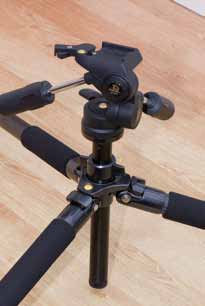
The legs are extended by releasing the snap action clasp which was secure during use with or without gloved hands to operate it. The three section arrangement carries the penalty of a longer unit when collapsed down. Fully closed it was longer than the largest LowePro bag favoured by Paul Gallagher.
Manfrotto 535 MPRO We asked to review this tripod following advice from Bogen's Vic Solomon at the Rutland Bird Fair. Intended for use with ultra-telephoto lenses, we accepted the weight of the 34mm diameter legs but the use of carbon fibre did reduce this to a minimum.
The unit carries a 75mm ball socket to which your chosen head is attached. This is a gem of a feature as we wished to add a Wimberley head and it could be levelled off reasonably easily (if manoeuvring an 800mm lens is ever easy!). You slacken the rubber stem underneath the tripod and roll the head into position until it is level. Providing you do this with some care the Wimberley will move and maintain a constant horizon as you track, say, a moving bird. Like the Giotto the hinges allow for three low-level positions, namely: 11, 20 and 27 inches to the bottom of the head.
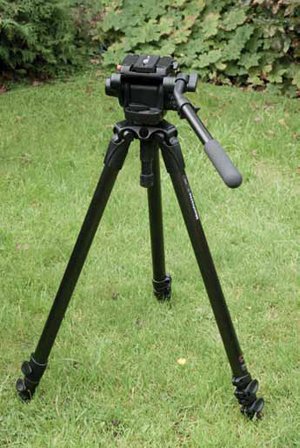
The tripod weight (5.1lb; 92.3kg), has a maximum rated load of 44lb and a folded length of 29 inches. It was provided in the natty 'quiver' opening carry bag which is useful if you tend to throw your gear about in the back of an estate car.
In use we found the entire set-up just about manageable. It weighed in at 22lb which is the weight of a small child. This was carried for four hours over a cross-country route of about 4 miles. After that length of time the 34mm leg resting on the shoulder felt like a pointed scalpel - the things we do for you, dear reader (and next time we will be wearing the powerlunch shoulder pads Posh Spice has promised us, failing that look at the Stealth Gear review in this issue). For somebody of your editor's stature (think small!) the reach to the first locking clasp is a little too far. The tripod was never used with the second leg at any stage, two sections were always high enough.

Since the bulk of the article was drafted we have had the opportunity to use the whole rig on a number of shoots. After a while different things become more apparent and in some instances little niggles start to show. Aware of this the manufacturers strive to continually update their product and we find that they are generally more attentive to the photographers' needs.
Flaghead Photographic have announced two new Custom Brackets Gimbal heads. They are the lightest and most affordable Gimbal heads yet and follow Jon Ashton's review a few months ago. We assume that the build quality is the same as it was (it was excellent) but they have managed to pare off a few more ounces which can only be a good thing. The other feature we have come to appreciate is the 'set-up and transport lock' of the Custom Brackets' designs. There is no doubt that your £5,000+ investment in lenses is most vulnerable as you set the lens onto it or if it slips off as you move along the trail. Most nature photographers move location/position with an ultra-telephoto lens attached to the tripod and with the junction of the lens's barrel and the tripod resting on their shoulder. This demands two things: a well-padded shoulder (see Stealth Gear review) and a certainty that the lens tripod combination is going to stay locked. In our experience the sound of a 10lb ultra-telephoto landing at your feet usually signals the end of the day's shooting! Moving about with a rig like this, trying to keep quiet and remain hidden is difficult enough without having also to worry if your gear is going to plummet to the ground. For the same reason, captive lens foot-plates are also vital in our opinion.
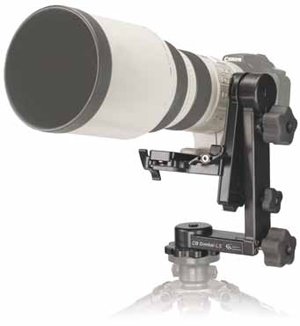
The Wimberley head has also been lightened and they have moved the knobs so that they are aligned one above the other. This aids fast locking and unlocking but the rotation lock is now sticking out, one more thing to chaff an un-protected shoulder.
Our comments about the need to handle tripods is equally applicable to counter-balanced heads such as the Wimberley and the Custom Bracket Gimbal. Flaghead will be present at the Convention so there is another reason to attend!

B.P.P.A. LIMITED
The Society of International Nature and Wildlife Photographers (SINWP)
Clwyd Chambers, Clwyd Street, Rhyl, Denbighshire, LL18 3LA, UK
Company Reg 0392 2894 | VAT number 790 4289 05
Tel: 01745 356935
Corporate Partners


Newsletter: Subscribe here
SINWP Bird Photographer of the Year
London Photography & Video Show - Europe's Largest 'All-Welcome' Photographic Convention | Partner Societies | Privacy