

articles/Nature/howtobuyalens
How To Buy A Lens
by Mike McNamee

In the previous article, Jon Ashton touched on the choice of lens for natural history and garden birds in particular. We decided not to waste the analysis we had conducted when trying to put some order in the price of lenses and this, in turn, morphed into this feature.
More than any other item, except perhaps for camera bags, the choice of lenses on offer is so vast that any decision to buy is a mass of compromises, a situation sometimes only solved by the purchase of more than one lens!
The decision to buy a lens runs something like this:
1. You have to start with a need for a lens, rather than a desire to collect neck-jewellery (leave that for the amateurs, but never forget - they buff up the profits so we can have what we need!).
2. What is the image you wish to capture and, crucially, how far away is it and how big? A secondary issue - 'is it dangerous?'.
3. What are your anticipated light levels and shutter speed requirements - this will determine your ISO requirements and may be reflected in your choice of camera body?
4. What are your depth of field requirements? For portraiture they may need to be minimal (buy a really wide-aperture lens!) and for macro they will almost certainly be as much as you can have (so other than assisting with focus, a wide aperture is a bit of a waste).
5. What is your budget? This may influence the decision to buy OEM, independent, second hand or even to hire a lens.
6. Think about secondary things such as weight, physical size, vibration reduction and how you intend to hold the camera. This has assumed greater importance if you have to travel on an aeroplane.
Does your intended use benefit from having a zoom facility? (see next section).

Zoom or Fixed?
Generally fixed focal length lenses (primes lenses) are less expensive than zoom lenses especially outside of the popular mid-range zooms. The aperture of a zoom lens may decrease with increasing focal length; check that your choice has enough light-gathering power at the long end.
It was always held that zoom lenses were not as critically sharp as prime lenses. More glass and more moving parts is never ever going to make a zoom sharper than a prime lens. However, with modern lens design (including the availability of new glass formulations and particularly, moulded aspheric elements), the difference between a zoom and a prime may be swallowed by atmospheric haze or camera shake. The same applies to stabilisation of lenses. Putting a slab of gimbal-mounted glass in an optical train is never going to improve performance on the optical bench, but birds and footballers don't sit on optical benches, they are in the field and moving!
The single greatest danger when using a zoom lens is zooming with the lens rather than your feet! A frequent criticism during qualifications adjudication (in particular for wedding applications) is that the photographer has remained rooted to the spot choosing inappropriate focal lengths instead of moving and then recomposing. A 100mm lens always was, and remains, the best focal length for a natural head and shoulders portrait (to full frame). Staying where you are and zooming wider will leave you with over-large hands and noses as often as not (think post football match interviews, always done in narrow corridors!).
One of the peculiarities of zoom lens use is a tendency to use them only at the extreme ends of their range. If you are one of these users you might ask whether two lenses or a lens and a teleconverter are your better options.
The Cost
The driving influence on the price of a lens is the diameter of the largest element in that lens. This is particularly true of telephoto lenses, less so for lenses around 50mm focal length and then true again for wideangle lenses of retro-focus (inverted telephoto) design. For the latter, in order to clear the mirror of the SLR, the rear element has to be moved away from the focal plane (by an inverted telephoto arrangement) which means that the front element of the lens is proportionally much larger and so the cost model comes back in again (study the graphs!).
In order to get the data onto a single graph (so we could look at it) we have plotted the 'Effective Aperture' of the lens against its street price. The effective aperture is simply the focal length (maximum for a zoom) divided by the maximum f-stop. For telephoto and telephoto zooms, the relationship is more or less linear, ie you get what you pay for - more focal length and more light-gathering power costs more money. As expected the relationship breaks down a little for lenses around 50mm focal length but then starts to sweep up again as larger elements are employed for short focal length inverted telephoto designs.
It is because aperture is the controlling influence on cost that you should spend the greatest time assessing just how much you need. Here is an example: if you are imaging morbid laboratory specimens (ie dead and not moving!) then an enlarging lens with an aperture of f5.6 and some form of bellows attachment is all you would need for imaging at a magnification of 1:1. You would slowly and carefully focus in what will be quite dim conditions, stop down, lock up the mirror and shoot. Things change rapidly if the specimen is a butterfly in the open. Now you have to focus really quickly and the f2.8 macro lens with an automatic aperture comes into its own, possibly with a bit of image stabilisation to help you as well. The difference in cost is many-fold.
Having a small aperture reduces cost but also reduces weight and increases portability. In today's air travel, weight may be critical - Ryanair will be rubbing their grubby little hands in glee as they see you lugging your 400mm F2.8 towards the check-in desk - and you thought you got ripped off for the lens!
Once you have fixed your mind on the lens' requirements you have to start agonising over whether you can afford it. In the UK at the present time you can get an OEM lens for around 70% of its SRP. If you are locked into a camera marque which offers an abundance of lens choice (eg Nikon or Canon) then you are likely to stay with your favourite and keep things in the family. If that is outside of budget you have very little optical compromise to make by moving to the independents (mainly Sigma with a little help from Tamron and Tokina).
On our graph the slope of the line in the telephoto part of the curves represents the average costs compared with the effective aperture. Thus Canon are the most expensive with a line slope of £90 per mm of diameter, then Nikon at £72 per mm of diameter and then Sigma at £50 per mm of diameter. The outliers on the graphs are caused by additional features such as zoom construction, stabilisers or the ability to close focus (although there seems to be little penalty for macro lenses).
Please note that these graphs are intended as indications only, you will have to do your own homework - remember, you are about to invest a load of cash from your business, you need to get it right. Talking of business, it is bad tactics to buy grey imports. The chances are that the low price is obtained by both tax and VAT avoidance. Your accountant and (heaven forbid) a VAT inspector will be asking for your paper work downstream. Should you break a lens the repairers may also need proof of import duty payment (Sigma certainly do). You have been warned!
lense options and pricesThe Alternative Solutions
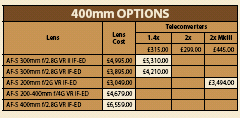
Even having considered the choices thus far you still have options. Suppose you need 400mm of focal length (or close to). You can achieve this with the following options from Nikon, for example:
The 200mm plus a 2x converter might be a good deal for someone who can also make good use of a fast 200mm lens (indoor sport?); the 200-400 for somebody for whom flexibility is paramount, but every ounce of light-gathering is not; the most expensive AFS 400mm F2.8 might be essential for the sports photographer shooting under floodlit conditions. On top of all this you have to throw in the effect of the chip size. So much choice and so few sheckles! These deliberations take no account of focusing speed, VR performance, weight or physical size - all are important!
What Actually Happens This is a secret between the photographer and like-minded souls! Often you end up buying the most expensive thing you think you can afford. Mistakes up to 200mm are relatively painless but things get progressively more injurious as you go bigger, either on your wallet or your neck. Never buy anything over £2,000 without trying it out and that includes hiring the brute for as long as it takes to get a true feel of it - what feels good on the shop floor at Calumet feels a whole bunch different after a day at an athletics meeting when you are sun-burned, dehydrated and hypoglycaemic!

B.P.P.A. LIMITED
The Society of International Nature and Wildlife Photographers (SINWP)
Clwyd Chambers, Clwyd Street, Rhyl, Denbighshire, LL18 3LA, UK
Company Reg 0392 2894 | VAT number 790 4289 05
Tel: 01745 356935
Corporate Partners


Newsletter: Subscribe here
SINWP Bird Photographer of the Year
London Photography & Video Show - Europe's Largest 'All-Welcome' Photographic Convention | Partner Societies | Privacy