

articles/Nature/goingintothered
Going into the RED
by Paul Gallagher

Paul Gallagher Landscape photographer Going into the RED
"...I made exposures of forest floors and partially shaded areas as well as the open landscape which gave me the opportunity to explore the subtleties that this camera can produce..."
My first encounters with infrared photography were when I was a young lad in college, studying photography. In those days all printing was done in darkrooms and all films were processed by the students, so black and white was the grounding for any would-be professional image maker. Aside from the usual films of the day such as Ilford FP4 and Kodak TMax, there was the occasional specialist film that was mentioned such as Kodak's wonderful Technical Pan with its extended red sensitivity and ultra-fine grain structure and the Kodak HIE Infrared Film.
As a student I was constantly striving for a full tonal range and fine detail following closely in the footsteps of Ansel Adams as much as I could with my rudimentary equipment. So the golf-ball grain of the Kodak infrared film with its harsh shift in contrast almost seemed to fly in the face of what I was trying to perfect - but I was intrigued.
When I had fumbled around in the darkroom trying to load the film into my Olympus OM10 (these film cassettes could not be exposed to daylight!) then I was ready to give it a go. Great mysteries surrounded the use of these films such as ISO rating, processing times, chemistry and focusing, but the one simple rule was to get out on a sunny day when the leaves were green. When I saw my first results I was nothing but chuffed. I loved the dream-like images of white, glowing foliage and blue skies rendered black as a backdrop to white clouds.
It was the answer to the age-old problem of not wanting to go out with your camera in the middle of a bright sunny day where the images always looked bland with short shadows and everything to see was evenly lit. Although I was impressed with the results and exposed many a roll of this film, I returned to my 'straight' black and white and left it behind.
In September of 2008 I received a call from Tony Howes of Advanced Camera Services who offered me the chance of trying out an infrared -converted Nikon D70. My first thoughts were that I was a large format photographer not using digital and I had not made an infrared image in many a year, but I agreed, once again intrigued. Digital cameras using CCD and CMOS chips are sensitive to the 'near infrared' but to avoid corrupting the image an IR blocking filter is built in.
This camera is modified so that it can only shoot in infrared and this is accomplished by removing the camera's infrared blocking filter and then installing an infrared filter which blocks visible light and is situated in front of the camera's sensor. The camera will then function normally in almost every way with full auto focus, auto exposure and normal through-the-lens viewing.

When I received the camera, the first thing I had to do was to get to grips with setting up the white balance. This was done by pointing the camera downwards and filling the viewfinder with grass illuminated by strong sunlight and making an exposure. I then set the white balance so that the green foliage that transmits infrared light was rendered as white, just like the films I had used. Over the next few weeks I had the occasional excursion with the camera and made some exposures which I then viewed back at my office using Photoshop.
These initial exposures served me well to gain an understanding of how the camera performs and what I was likely to get. I quickly discovered that it was extremely simple. I set the ISO to 200 and captured in RAW using a tripod, as I always do, but you could just as easily point and shoot. I occasionally adjusted the exposure compensation up or down to gain the effect that I wanted (bearing in mind infrared light changes quickly and you cannot see it - it is invisible). The preview and histogram was a luxury having been used to film and waiting weeks to see the results!
Now feeling confident, I packed it into a bag and headed for Glen Coe and the Outer Hebrides. I was fortunate to get good weather for weeks with strong sunshine in early spring with fresh greens all around me. The trip was essentially to gather more images for books but I found myself getting the IR Nikon D70 out of the bag more and more often and making images. I walked around lochs, into woodland and onto the beaches of Harris and Lewis and the results where exactly what I wanted.
It is worth bearing in mind that infrared photography is not simply about black skies and harsh whites but you can use the camera to make composition of subtle differences in tones that are sometimes more rewarding. I made exposures of forest floors and partially shaded areas as well as the open landscape which gave me the opportunity to explore the subtleties that this camera can produce.
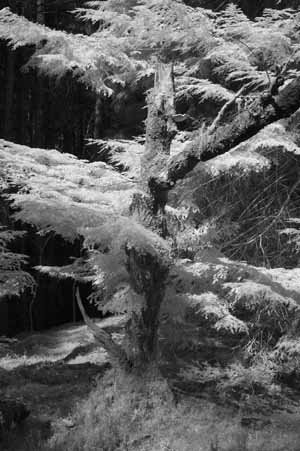
On my return I converted the images into monochrome using Photoshop and with a few simple adjustments using colour sliders in the black and white converter, and some simple selections with curves, the images came to life. I was taken by the clarity and quality of the images from this camera and could not pull myself away from my monitor until I had processed many of the image files.
If I had not received that call from Tony Howes I suspect I would never had ventured out again with the aim of making infrared images of the landscape. The more I use the camera the more I am impressed by its simplicity and the fact that it achieves all I could have done years ago in the darkroom. It is indeed a superb piece if kit and one that I suspect will regularly accompany my Ebony 5x4 when I venture out, so I will be able to take back home with me those moments of infrared that I have ignored since my student days.

B.P.P.A. LIMITED
The Society of International Nature and Wildlife Photographers (SINWP)
Clwyd Chambers, Clwyd Street, Rhyl, Denbighshire, LL18 3LA, UK
Company Reg 0392 2894 | VAT number 790 4289 05
Tel: 01745 356935
Corporate Partners


Newsletter: Subscribe here
SINWP Bird Photographer of the Year
London Photography & Video Show - Europe's Largest 'All-Welcome' Photographic Convention | Partner Societies | Privacy