

articles/Nature/getinspiredbyflowers
Get Inspired by Flowers
by Andrew Williams

Flowers are a popular subject for many photographers captivated by the sight of a wild flower meadow, a stunning garden or maybe a single rose from the florist. You do not have to be a keen horticulturalist, steeped in Latin names, to appreciate the ephemeral beauty of a flower with their wide range of textures, colours and shapes, which is just as well since I have no such skills in the garden; just ask my wife!
As with many branches of photography there are alternative approaches to flower photography, from the pin-sharp-throughout more documentary style, through to the more artistic approach, where the subject may not even be identifiable. Both approaches are, of course, valid and in commercial work may be dictated by the customer's needs.
A botanical text book requires a different approach to a fine art print. All photographers develop their own style and my approach falls into the more abstract representation category, driven by an emotional response to the subject. In particular I get attracted to small details selected from the bud, flower or seed head such as the edge of a petal or a contrasting area of colour.
So what do you need to take successful flower photographs?
Lens Choices
You do not need a vast amount of extra equipment to start taking flower photographs. Although you may be limited in the type of images you can take, even a simple compact camera can give good results.
However, if you want to get close enough to fill the frame with tiny flower details, you will need to focus closer than most lenses can achieve. There are several options for this.
If you are just starting out and want to try close-up photography without great expense; you can buy a close-up filter. These are basically a magnifying lens which screws onto your existing lens's filter thread. They can be bought in different strengths from +1 to around +10 dioptre and start at about £20 (although you can pay up to £150 for a coated, two element lens). As you would expect the image quality can be poor and chromatic aberration is common, but they are a good starting point, particularly if stopped down.
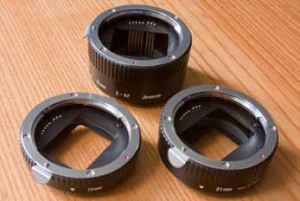
One step up in price and quality is the extension tube. These are basically a spacer which moves your lens further away from the sensor, so the projected image is larger. As there are no lenses within the tube, quality is not compromised. Because the light entering the lens is spread over a larger area, less falls on the sensor so longer exposures are needed. As most macro photography involves using a tripod this isn't too much of a problem.
Extension tubes give the most magnification increases with shorter focal lengths and also work well with short zooms. Most tubes include connections so your camera's exposure metering still works and prices start around £145 for a set of three different lengths.
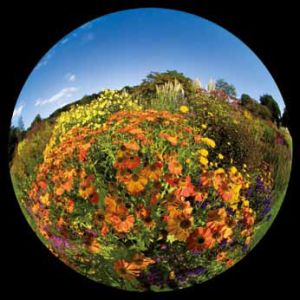
A typical zoom lens with 'macro' setting will not get close enough. Unfortunately the term 'macro' has been seized upon by the marketing men to mean the lens focuses 'closer than normal' (whatever that means). A true macro lens is distinguished by the ability to create at least life sized image on your film, or sensor, at its closest focal distance.
These solution work well but once you get hooked on the detail revealed when working close up with flowers you will crave a macro lens. These prime lenses are specifically designed for close-up work (although they still focus to infinity and make good portrait lenses).
There is a range of focal lengths from 50mm to 180mm. The longer focal lengths are good for subjects where you cannot approach too closely such as dragonflies. For flower photography 90 to 100 mm is a useful length. I use an f2.8 90mm Tamron and an f2.8 150mm Sigma. They both give excellent image quality; the Sigma scores for me in using internal focussing so the lens doesn't extend as you focus. I've often had problems focussing before realising that the Tamron's lens hood is pushing the subject further away!
Which Tripod?
For me the other indispensable piece of equipment is a solid tripod. It is possible to hand hold close-up shots but as well as considering camera shake you also have to consider holding your camera still in the fore/aft direction. With very limited depth of field it is easy focus on the wrong point.
There are a couple of features to look for in a tripod used for flower photography as well as the usual issues of weight versus stability.
1. It is really useful to be able to position the centre column at any angle so you can position your camera at any angle.
2. Another handy feature is to let you position each leg independently as flower beds often have walls, slopes, etc, which impede the legs.
A good budget tripod with these features at around £110 is the Benbo Trecker. Benbos take some getting used to (a bit like putting up a deckchair) but, once mastered, they work well. I also use a Gitzo Explorer carbon fibre tripod which has proved to be strong, light and reliable. Don't forget to budget for a tripod head, I use the Manfrotto 460MG which allows almost unlimited camera positioning but you may prefer a ball head.
Other handy equipment
A remote control for your camera is essential for preventing camera shake. A simple wired release is fine; I like to use a wireless release so you can watch the subject whilst waiting for a break in that pesky breeze!
A small kit of clothes pegs, Velcro loops, canes, etc is handy for keeping stray stems or leaves out of shot. Just remember to go gently and put everything back how you found it.
beautiful pink flowerOn a bright day small reflectors can be used to bounce light back into the deepest shadows. You can make your own by gluing crumpled aluminium foil onto card.
Finally something to kneel or lie on will reduce the pile of washing!
Technique
With close up flower photography it's all about depth of field. Even at f/16 you will only have millimetres to work with. Most of the time I work using Aperture Priority mode to control the depth of field and manual focus as auto focus is slow with macro lenses and may not snap onto the point you want.
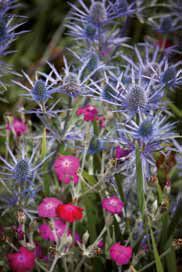
You can use the shallow depth of field as a creative tool by focussing on part of the flower such as the stamens or the edge of a petal and letting the rest blur into the background.
Whilst we're talking about backgrounds, try to select something with a complementary colour maybe 2-3 metres behind your subject. Some people take their own printed background to slip behind the subject; but I find that by carefully choosing your viewpoint you can often use other plants and flowers to good effect.
As always the lighting is critical. A bright overcast morning is often best, just think about the sky as a huge soft box. So how do we deal with bright sunny days? Well you can adapt your style. Some translucent flowers and leaves look stunning when back lit revealing detail you wouldn't otherwise see. Alternatively create your own shade over the subject. A willing partner is handy for this!
Another issue can be strong breezes. If you cannot get a high enough shutter speed then use the movement to your advantage. Either use a tripod-mounted camera with a long shutter speed or maybe hand-hold the camera and move it as you take the shot for an abstract effect. Digital cameras really score here as it is difficult to judge the combination of shutter speed and speed of movement without some experimentation. So have a play!
One last tip
If you are shooting in a garden with labelled plants, don't forget to shoot the label. Just remember it doesn't matter whether you shoot the plant then label or the other way round but be consistent!
I shall be covering this subject in more depth in my Masterclass 'Flower Photography Up Close and Personal' at The Convention, Saturday 15 Jan 13:00 - 14:30. I hope to see you there.

B.P.P.A. LIMITED
The Society of International Nature and Wildlife Photographers (SINWP)
Clwyd Chambers, Clwyd Street, Rhyl, Denbighshire, LL18 3LA, UK
Company Reg 0392 2894 | VAT number 790 4289 05
Tel: 01745 356935
Corporate Partners


Newsletter: Subscribe here
SINWP Bird Photographer of the Year
London Photography & Video Show - Europe's Largest 'All-Welcome' Photographic Convention | Partner Societies | Privacy