

articles/Cameras/fives
All at sixes fives and sevens
by Jon Ashton
This brief review started with an attempt to see if the extra chip area of the 5D and the newer design, could provide a tangible benefit under very difficult shooting conditions and trump the doubling of cost overthe older 7D. The two cameras are aimed at slightly different marketswith the 7D targeting the sports and wildlife sector while the 5D Mk III aims slightly higher at the pricier professional studio and social photographer. These demarcations, though, are a bit arbitrary and we were curious to look at the benefits of the larger chip of the 5D in terms of image quality. The two cameras may be summarised as follows:
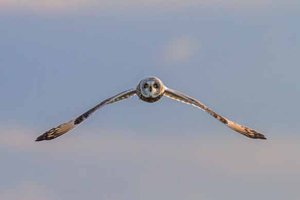
We had a specific trial in mind in order to torture the 5D. The Dee Estuary is home to a transient population of short-eared owls who patrol the reedy marshes, hunting for voles. They are beautiful, majestic birds who are reasonably accommodating in terms of human presence but can be very illusive. Infuriatingly this turned out to be the case, Jon Ashton had wonderful images with his 7D but then, during the 20-day testing window available, not a one was seen - that's wildlife photography for you! Shorties present the photographer with a great challenge; they fly mainly at dusk and dawn although they do need enough light to hunt well. However, attractive though the autumn light is in terms of quality, it is never strong and a severe challenge to optics, focusing, camera noise and hand/eye coordination! Additionally the marshes provide a vast area for hunting and the birds are as likely to be way out of reach as patrolling right in front of you. A 500mm lens is considered the shortest you can get away with and converters are frequently employed as well.

In use Jon did not detect much difference between acquisition of the target and focus lock-on although he did get the impression that the 5D was better able to stay locked on during flight tracking. Other reports confirm that the focus of the 5D Mk III is superior to the 5D Mk II.
Given that cropping is likely to be essential, the residual noise of the chip becomes important. In this department the 5D Mk III is superior, an expected result with the pixel sites being larger. The opening image of this piece is made without scaling the resolution from the camera. At 300ppi, the native image size is 48.8 x 32.5cm (19x13 inches nominal) which is more than enough to cover a double-page spread in Professional Imagemaker and the image has been placed over to the left and to the bottom - effectively a 2-inch crop to the side.

We conducted a sharpening test ring around to determine the optimum parameters. We found that the 5D needed less sharpening than the full-chip Nikon D700 and a lot less than the massively pixelled Nikon D800. This can be interpreted in two ways but what we are saying is that smaller values have to be employed before sharpening becomes obtrusive, so the 5D needs a lighter touch than a D700 or D800. The opening spread used 40 Amount, 0.5 Radius, 80 Detail followed by use of 50% opacity in the High Pass layer (Pixel Genius parameters).
To smooth out the noise we also applied a Masking setting of 80 for the actual image (which was shot at 800 ISO, 1/800s f5.6, EF500mm f/4L IS USM).

Colour Testing
We did not pass up the opportunity to test the colour accuracy of the 5D. We shot bracketed sequences of a Macbeth Chart and then applied the Rags Gardner ACR calibration and audit methods. This was done at 200, 400, 1600 and 6400 ISO settings. The average residual errors ranged around 3.75 ?E00 and in the main the Raw camera calibration settings were similar across the ISO range. Although the values were not outstanding, the very cool light quality (10,000 Kelvin) might have compromised them and the colours were perfectly acceptable for professional use. At each ISO setting the exposure accuracy was within three tenths of a stop.
This heron was not even visible in the gloom! At the other end of the scale (above left) the chip copes well boring right into the sunshine.

This was an impressive test even if it was only a short look and the owls did not come out to play! The large chip does provide tangible benefits for many situations but the shorter (but truer) effective focal length would tend to swallow some of the benefits when compared with the 7D as more cropping would often be required; even so the extra fire power of the full-chip probably shades the decision even if it does cost the best part of £1,000, especially for professionals for whom the cost is less of an issue.

B.P.P.A. LIMITED
The Society of International Nature and Wildlife Photographers (SINWP)
Clwyd Chambers, Clwyd Street, Rhyl, Denbighshire, LL18 3LA, UK
Company Reg 0392 2894 | VAT number 790 4289 05
Tel: 01745 356935
Corporate Partners


Newsletter: Subscribe here
SINWP Bird Photographer of the Year
London Photography & Video Show - Europe's Largest 'All-Welcome' Photographic Convention | Partner Societies | Privacy