

articles/Lens/ctt
Charlotte Takes a Tilt
by Mike McNamee
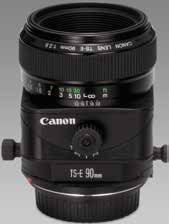
There's something extraordinarily beautiful about the Canon 90mm TS-E lens. I challenge you not to be impressed by the way that the mechanisms work so smoothly and the smart engineering that makes it all possible.
It's a heavyweight piece of kit - both literally and figuratively. It weighs in at a hefty 645g and is the kind of top-end specialist kit that you would only really expect to find in a specialist product photographer's arsenal.
So why does it still find a place in my own kit? I gave up shooting products several years ago but I could never quite manage to sell this lens off. With a £1,200 price tag (and the Nikon 85mm version coming in at a touch more) it is a luxury to keep around for the rare moments I do use it and I'm sure that money could be put towards something that I really need. However, my heart tells me to keep it.
Not just because I love to hang on to curiosities (and this really is a wonderful object just to have - it sits on my desk for much of the time where I play with the mechanism in idle moments) but also because there is the odd occasion where it can be used creatively to give a shot something that is just a little bit different.

Now I wouldn't suggest that you put together a whole portfolio full of shots that were taken with a Tilt-Shift lens as that would quickly become repetitive. However, throwing one or two in amongst your other shots can really add something different to your image selection. It is, like anything else, a technique that has a time and place to be used, but it is a valuable one to add to your toolbox that can add variety.
For me the largest benefit of using a TS lens is that it causes me to slow down and think about exactly what I'm shooting. Not only do you have to manually focus but also you have to choose exactly where you want to focus and which parts of the shot you want to defocus - manual focusing with the Canon 90mm TS-E is hardly a chore though considering the large and smooth focus ring that you have to use. In addition, the lens has great contrast and saturation and is fantastically sharp when used without a tilt. On a full-frame camera body the sharpness goes all the way to the edges, making this a great choice for a portrait lens. Indeed if I didn't already own the Canon EF 100mm f2.8 USM Macro for portraits, this may have been my go-to lens instead. The only real downside is that sharpness falls off quickly the more that you tilt the lens. However, since there is no real competition in the TS lens category, it's hardly something that can be fixed by choosing a different brand or product.
So while we're all familiar with the 'toy-town' effect that many use a TS lens for, here's some other ideas for the kinds of shots that can be produced when you get creative with a lens capable of tilting the focal plane.
People
One of the most beautiful features of this lens is the sharpness and the bokeh. For that reason alone it's worth using frequently as a portrait lens. It has an unmistakable watery quality that is hard to describe adequately. The blurred areas aren't just blurred; they flow and blend into the in-focus areas in a way that not many other lenses can manage.
By using a severe tilt on a portrait shot, you can lead your viewer's eyes to wherever you want them to go. They'll naturally find the sharp point of the image first, before letting their eye wander to the other areas of the image. Along with colour and composition this can be a useful way to control where your viewer looks and what they see first.

Grabbing the lens while shooting nudes can present you with a whole new way of creating mystery around your subject. Photographers shooting boudoir are often asked to preserve their subject's modesty and the tilt lens is another tool in the bag to do so. Defocusing the body in a straight-on nude shot allows every part of the body to be visible while the details remain hidden.
Taking it outside
Of course using a tilt while shooting isn't limited to the studio. Its natural habitat is outside in the urban jungle stopping buildings falling over by correcting converging verticals for architectural imagery.
However, there are other great uses for a tilt lens too, especially during a wedding or a commercial shoot.
Albums with the feel of a designer magazine are all the rage right now and that means shooting with room for copy. Photographers are increasingly getting creative with all kinds of text and graphic overlays to get the designer feel that their clients want and using a TS lens to create an image can help you achieve that goal. Corporate brochure images, advertising shots and the front cover of a magazine can all benefit from having a great out-of-focus space to use for text too.
The look of the compound blur created by the TS lens can also result in a feeling of movement in the image as the bokeh almost swirls around.
With the ability to force the eye to one spot, throw unexpected areas out of focus and give a feeling of movement, a TS lens can be an interesting choice for some creative sports photography. It will require you to brush up on focussing techniques with manual lenses for sports; I have found visualising the image and pre-focussing on a spot the best way to shoot anything with action - as well as an awful lot of trial and error. I wouldn't have liked to try this approach out if I was being forced to use film!
Photoshop Comparison
Of course there's every reason to ask the question of why you would spend around £1,200 or more on a specialist lens when the latest version of Photoshop has a tilt-shift filter built in. So in the interest of deciding if I should really sell my lens or not I road tested the filter on a portrait shot - one of my favourite subjects to shoot with this lens.
The filter isn't complicated to use but it has several parameters that you can adjust. The basic premise is that you can change where the blur is applied and how strong the effect is. The tilt-shift filter presents you with a circle and a set of horizontal bars. The centre circle is where you want the focussed part of the shot and the bars indicate the boundaries of that focus before the blur is introduced. In addition, the blur radius can be changed too, effectively changing the strength of the blur on the outof-focus areas.
As you can see from the sample shot, the downside to the Photoshop filter is that it doesn't work in the same subtle and nuanced way that a genuine TS lens does. Photoshop doesn't have the intelligent ability to create the same kind of effect, although by all accounts Adobe After Effects can produce a more similar effect to a TS lens.
It may not be worth buying a lens capable of tilting the focal plane if you're only going to use it on the occasional wedding or portrait shoot because the Photoshop filter is convincing to an untrained eye. However, for those photographers looking to use it for more subtle imagery such as fine art nudes or on commercial images that will be under serious scrutiny, it might just be worth renting or buying in order to get the full effect.
Alexander Kharlamov
Born in 1988 in Moscow and moving to the UK in 2012, Alexander Kharlamov is an engineer with a passion for photography. His beautiful nude images were photographed using a custom-made lens that was developed by his friend Manuel Figueiredo called the TS-Kardan MF - of which there are only two in the world. 'The lens is designed for portraits.'
Alexander says about his friend's creation. 'It is an amazing set-up that allows 45 degree tilts with extremely soft and contrasty optics that were not developed for digital.' It's no wonder that Alexander's work has a dreamy feel to it when you consider the lens used to produce it! The lens comes in at about a 110mm equivalent on a full-frame digital camera, just a little longer than the offerings by Canon and Nikon, although a world away in look and feel.
But what was it that made Alexander pick up a TS lens rather than a Convention lens for these shots? 'I've been shooting for many years and normal lenses started to get boring. When I went looking for different effects I was drawn to the tilt-shift lenses because of their unique properties.' Alexander's engineering background sheds some light on his choice too; 'TS lenses remind me how human eyes work because they can selectively focus on an object and throw the surroundings out of focus.
You can use the tilt effect to help guide the viewer's eye better through your compositions.'
www.ak-arts.com

B.P.P.A. LIMITED
The Society of International Nature and Wildlife Photographers (SINWP)
Clwyd Chambers, Clwyd Street, Rhyl, Denbighshire, LL18 3LA, UK
Company Reg 0392 2894 | VAT number 790 4289 05
Tel: 01745 356935
Corporate Partners


Newsletter: Subscribe here
SINWP Bird Photographer of the Year
London Photography & Video Show - Europe's Largest 'All-Welcome' Photographic Convention | Partner Societies | Privacy