

articles/Nature/colourmehappy
Colour Me Happy
by Paul Gallagher
No don't go thinking that the Editor has put the wrong images in the Paul Gallagher article because you will be wrong. Yes, these are colour images, and yes, I took them! I was at Focus on Imaging in Birmingham last week and I actually printed some of my colour work off and displayed it on the Epson stand with my name on the bottom, next to the title. I was quite surprised by the response this got from some people.
For those who did not know me, the images were very well received and I was pleased to hear some very kind compliments. This was also the case with people who knew me, but their compliments were preceded with rather odd reactions. In the main the initial reaction was as if I had begun to shoot nudes or taken up flower photography because they were often heard saying things like, 'Hold on what is going on here!' Or some folk exclaimed, 'Goodness me these are in colour!' In some way I felt like I had 'broken new ground' and perhaps betrayed the dedicated follower of the monochrome image. If, however, I was a colour photographer and decided to convert some of my images to monochrome then I suspect the reaction may not have been so strong or maybe no reaction at all.
Although I have dedicated the vast majority of my photographic career to perfecting the monochrome image of the landscape, I do still love colour work and admire the achievements of friends such as Joe Cornish and Charlie Waite. The fact is we all should try both colour and black and white and see for ourselves which one lends itself to our personal striving for expression through photography. I have been intending to get out there and make some colour photographs for some time.
However, because I have been writing books on monochrome and I am generally known for my monochrome work I have not found (made) the time. Even when I was faced with a situation presenting itself both in colour and black and white, I have been almost duty-bound to get my large-format camera out of the bag and expose a sheet of black and white film.
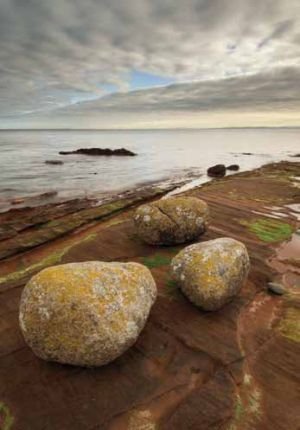
Things changed slightly last year when I went on two trips equipped with the wonderful Nikon D3X and a 24mm PC-E lens. This camera-lens combination gave me the quality approaching my 5x4 camera because of the lens movements and the large sensor and I could shoot in RAW and convert to monochrome when back at home. As I looked at the digital files I found that I kept some in colour and converted some as intended.
This then led me to make a trip to Sutherland for a week where I decided that I had to dedicate some time purely to the colour image. This approach is easier for me, and the only real way that you can allow yourself to 'see' in colour, as opposed to trying to switch between monochrome and colour. I have had many clients complain that their monochrome images never really stand up to much and I believe this is because rarely can you get out there and 'fall-upon' a good monochrome image.
You have to 'look' then 'see' in monochrome. It's a trained process called 'visualisation' where you eliminate the colour information and replace this with the luminosity of the light reflecting off the landscape. When I got back from Sutherland I also took digital cameras to Perthshire and Kintyre, and enjoyed the freedom of exploring colour once again. The most apparent advantage is, rather obviously, the reduced weight and bulk of a digital kit compared to my Ebony 5x4 gear. It was liberating to take a small bag and tripod. Setting up was easy and quick, and I could catch moments of light I would have to wave goodbye to with a large-format camera. During all this enjoyment I did, however, place some old-fashioned restrictions on myself. I used a tripod for all the exposures and I would not let myself fall into the habit of taking thousands of images and sift through the rubbish on my return to find the good images.
So, in short, I worked in much the same way as with my large-format kit but never had to worry about the cost and time implications of the film. It was a great experience to switch my mind into a mode that could accept colour in the frame as an integral part of the composition. Although some of the images I made contained bright vibrant colours, I still found myself favouring other scenes where the light was subtle and the colour contrasts low, which is what I also do when working in monochrome.
One very important thing did get carried from my black and white image -making into the colour world and that was seeing the structure of the landscape and elements of the composition itself. I see quite a few colour images fail because the photographer has been almost overwhelmed by beautiful colour in a scene but when this is presented in an image it means 'less' and the translation is simply colour without structure. The one thing monochrome teaches us is that you must understand form, line and texture in your image because the luxury of colour cannot help you out!
All of the images were shot in RAW and mostly processed in Camera Raw, back at my office. Other than retouching, I did little to alter them. I must confess the whole process was great and in this age of digital I will once again venture out with the sole aim of making colour images of the landscape. They hopefully say something about my experiences out there. If you are wondering if this is the slippery slope upon which Paul Gallagher will slide into the digital colour world and divorce himself from his wooden field camera and the black and white image you have come to associate me with then the answer is a definite no!
As a lad when I first looked at the black and white pictures from the American masters I was changed and that process was dyed in the grain in that college library, at the tender age of 16.

B.P.P.A. LIMITED
The Society of International Nature and Wildlife Photographers (SINWP)
Clwyd Chambers, Clwyd Street, Rhyl, Denbighshire, LL18 3LA, UK
Company Reg 0392 2894 | VAT number 790 4289 05
Tel: 01745 356935
Corporate Partners


Newsletter: Subscribe here
SINWP Bird Photographer of the Year
London Photography & Video Show - Europe's Largest 'All-Welcome' Photographic Convention | Partner Societies | Privacy